Theodosia’s Ability to Sense Curses
Theodosia and the Serpents of ChaosTheodosia’s Ability to Sense Curses is an unusual form of direct perception that reveals black magic clinging to ancient artifacts before other people recognize any danger. It announces itself through a bodily sensation, and, under moonlight, becomes a way to see the curse itself as moving hieroglyphs. The gift is both a warning and a practical investigative tool: it tells Theodosia when an object is dangerous, while setting her apart from the adults who handle such objects and from the established methods used by Lord Wigmere’s associates.
Identity and First Manifestation
The ability is introduced through Theodosia’s response to a black Bastet statuette, identified as an Egyptian fertility goddess. The moment she sees it, she feels as if “a parade of icy-footed beetles were marching down my spine.” The sensation arrives before any explanation or test: her body registers the object as threatening, while the people around her do not. Her cat, Isis, also reacts to the statue, meowing loudly and darting away; the contrast makes the object’s arrival feel ominous even before Theodosia can identify the nature of its curse.
The physical warning is not merely a vague dislike of the artifact. Theodosia understands it as evidence that ancient black magic remains attached to the object. She later explains that the same beetle-like sensation comes when she first lays eyes on a bespelled artifact. In her account, the gift has been present since she was very young, though she initially assumes that other people detect spells in the same way. That assumption underscores how ordinary the experience has seemed to her and how unusual it is to everyone else.
How the Ability Works
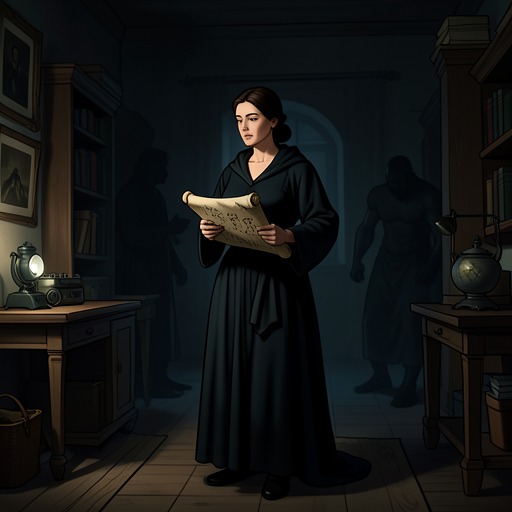
Theodosia’s perception operates at more than one stage. The immediate sensation alerts her to an artifact’s dangerous condition; if an object passes the wax test, she proceeds to a Level Three Test, the Moonlight Test. At night, moonlight allows her to see curses moving over an object as hieroglyphs. She describes them as swimming, like a swarm of bees seeking someone to sting, and says they give off a buzzing feeling. The imagery joins sight and sensation: the curse is not static writing but something active, moving, and threatening.
Lord Wigmere asks whether the hieroglyphs tell her what the curse is. Theodosia corrects the premise: they are not merely signs that describe a curse but the curse itself, written on the object by whoever placed it there. Her gift therefore gives her access to the inscription’s presence in a way that differs from ordinary inspection. It does not simply alert her to a general atmosphere of danger; under the right conditions, it reveals the visible form in which the curse was written.
Difference from Other Investigators
The ability is defined as much by its rarity as by its sensations. Theodosia believes she is the only person who can detect the black magic clinging to ancient objects. Her parents do not sense it, and the assistant curators seem not to notice it either. When the Bastet statuette arrives, they do not share her immediate alarm. The result is a gap between what Theodosia knows through perception and what the adults around her can see or accept from ordinary observation.
Lord Wigmere’s response confirms that her experience is exceptional even among people who know spells exist. He recognizes the subject when she mentions spells, but he does not see curses in moonlight or feel them through the same bodily warning. Instead, he says that his group’s methods are more mundane and laborious. He regards Theodosia’s ability as remarkable and observes that it would save them a great deal of time and trouble. The exchange changes her understanding of herself: what she had taken for a normal way of identifying spells is, to Wigmere, a rare practical gift.
Responsibilities and Significance
The gift immediately creates work. Because the adults around her cannot reliably recognize the curses, Theodosia concludes that she must discover the statuette’s curse and how to remove it, and must do so quickly. Her sense of obligation is sharpened by the prospect of more artifacts arriving: her mother is due the next day with additional objects, and further crates are expected over the following weeks. The possibility that many of them may also be cursed turns one alarming discovery into an ongoing responsibility.
That responsibility also shapes Theodosia’s place in the household. She anticipates that examining the incoming artifacts could keep her occupied for months and out of her parents’ way; they become annoyed when she is underfoot and talk of sending her away to school. At the same time, the work gives her a reason to spend time with her mother. The ability thus links danger to a more ordinary domestic concern: it makes Theodosia useful in a world adults fail to read, while offering her a task that keeps her near her family.
Its narrative significance lies in this double function. The beetle-like warning makes the supernatural threat legible through a recurring physical cue, while the Moonlight Test develops that cue into a method of investigation. The contrast with Lord Wigmere’s slower procedures also establishes Theodosia as someone whose perception can contribute knowledge unavailable to experienced adults. Her gift does not itself remove a curse, but it identifies the problem, exposes its written form, and places the next step in her hands.